
Shut Up and Listen
Religious Conversions and St. Mary of Bethany

I had the unfamiliar but very pleasant experience Friday afternoon of looking at my to-do list and seeing that all the tasks I’d committed to completing during the week were, in fact, done. It seemed like a good time to dust off the ol’ Substack account after a couple of months away and see if I could get myself back into a writing groove.
So, naturally, and like any serious writer, I immediately logged into Facebook instead.
For the first time in my life, I am glad I did. An old acquaintance of mine—let’s call him Mike J. (for the very good reason that that is his name)—had posted something that caught my eye. I know Mike from grad school; he was a year or two ahead of me in the philosophy PhD program at The Ohio State University. We were never especially close, but we always got along well. I was the grader one semester for a course he taught, and he and I along with a couple of other grad students would occasionally read and discuss scholarly essays about the existence of God and other topics in the philosophy of religion. We also played basketball once in a while. Mike never struck me as hostile to religion, but he also seemed like someone who kept it at arm’s length. If I had to guess at what his actual beliefs might be, I’d probably describe him as a friendly agnostic: quite open to the idea that there’s something spiritual behind or beyond the physical world, but skeptical of any dogmatic assertions concerning what that something might be. In other words, he struck me as a sophisticated version of the “spiritual but not religious” person with whom we’re all probably familiar.1 A good guy, for sure, but not someone who seemed likely ever to become a Christian.
I was quite surprised, therefore, to see a post from Mike expressing gratitude toward the recently deceased Protestant preacher John MacArthur.2 I went to his Facebook page and started scrolling, in hopes of learning more about his stance toward religion. Fortunately for me, Mike doesn’t post as much as I do on social media, and a few seconds of scrolling was sufficient to cover sixteen months’ worth of content. In March and April of 2024, I discovered, Mike had written a six-part series of long Facebook posts explaining his religious journey from childhood through the present. He’s set all of them to be publicly visible, so I suppose I’m not betraying his confidence if I tell you that you can find the whole series here. Spoiler alert: it ends with the astounding (to me) and rather beautiful passage below. Mike writes,
I’m still taking it slow as far as settling on specific doctrines I would defend and worship traditions I would participate in; guidance will come when the time is right. But I am ready to proclaim this much. I was asked in the comments on Part One, Who is the higher power? Who is it that reveals true wisdom? And, at this point in the now 30+ year journey since my original spiritual awakening in high school, I am finally ready to give my answer:
The God of Abraham, Isaac, and Jacob. The God of Moses and Elijah. The God of David and Solomon. The God who so loved the world that he gave his only begotten son to die on the cross for our redemption. The Father, The Son, The Holy Spirit. The almighty creator, the risen savior Jesus Christ, the unfailing guide to the faithful who kept calling to me and calling to me though I heard but did not answer. Until now.
Here I am, Lord.
As another OSU-philosophy-PhD-agnostic/atheist-turned-Christian-convert responded when I encouraged him to read through Mike’s posts: I’m not crying; you’re crying.
One of the things that struck me about Mike’s journey from agnostic to Christian, at least as he tells the story, is that even though he himself is a professional philosopher, philosophical reflection seems to have played merely a supporting role in his conversion, at most. He wasn’t argued into the faith. Few people are. Now, my own take is that philosophical arguments really do provide a firm intellectual foundation for religious belief—indeed, in accordance with the Catechism of the Catholic Church, I believe that we can know that God exists on the basis of reason alone; I’ve written a little bit about that here and will almost certainly continue to do so in the future—but for most people, most of the time, philosophical arguments are primarily helpful for clearing away various kinds of obstacles and intellectual stumbling blocks. They rarely lead to authentic faith on their own, but they put us in a position to be able to take seriously the claims of the Gospel, to receive the Good News about Jesus as something that could actually be true, that might actually have a claim on our lives.
Ruminating on this, it occurred to me that there is a very straightforward connection between these ideas and the Mass readings for this Sunday, the sixteenth Sunday in ordinary time. The Gospel this week is the famous anecdote about Mary and Martha. It’s short, so I’ll give the whole text from Luke chapter 10:
Jesus entered a village
where a woman whose name was Martha welcomed him.
She had a sister named Mary
who sat beside the Lord at his feet listening to him speak.
Martha, burdened with much serving, came to him and said,
"Lord, do you not care
that my sister has left me by myself to do the serving?
Tell her to help me."
The Lord said to her in reply,
"Martha, Martha, you are anxious and worried about many things.
There is need of only one thing.
Mary has chosen the better part
and it will not be taken from her."
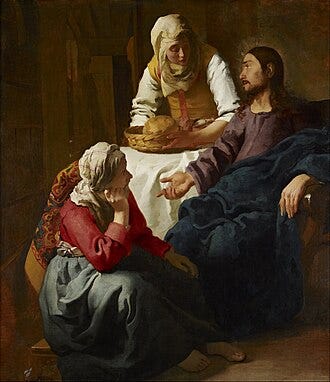
Now, at its core, this story is surely not about the role of philosophy and intellectual argument in religious conversions. Whatever Martha’s shortcomings may have been, they have no apparent connection to an excessively rationalistic approach to faith. But the idea that the “one thing” of which there is need is simply to listen to the Lord is right in line with my friend Mike’s conversion. If you read his account of that conversion, you’ll find that the crucial move he made was simple: he read the Bible. He made a decision to approach it not as a critic, nor as a believer, but just as a reader, trying to engage with it on its own terms. Somehow, through that, he heard the voice of God.
In another of today’s readings, St. Paul refers to the gospel message as “the mystery hidden from ages and from generations past,” writing that
now it has been manifested to his holy ones,
to whom God chose to make known the riches of the glory
of this mystery among the Gentiles;
it is Christ in you, the hope for glory.
It is he whom we proclaim,
admonishing everyone and teaching everyone with all wisdom,
that we may present everyone perfect in Christ.
This is from the opening chapter of Paul’s magnificent letter to the Colossians, one of the apostle’s more mystical and metaphysical bits of writing. Last week at Mass, we heard what precedes it:
Christ Jesus is the image of the invisible God,
the firstborn of all creation.
For in him were created all things in heaven and on earth,
the visible and the invisible,
whether thrones or dominions or principalities or powers;
all things were created through him and for him.
He is before all things,
and in him all things hold together.
He is the head of the body, the church.
He is the beginning, the firstborn from the dead,
that in all things he himself might be preeminent.
For in him all the fullness was pleased to dwell,
and through him to reconcile all things for him,
making peace by the blood of his cross
through him, whether those on earth or those in heaven.
My usual approach when commenting on texts like these is to unpack big ideas that may be unfamiliar to the average layperson, trying to make sense of them in various ways, showing how they connect to philosophical issues of various kinds, and/or attempting to defend them against criticisms and provide rational grounds for believing them.
Today, I’m just going to try to hear them.
If I may be so bold, let me invite you, dear reader, to join me in attempting to adopt the stance of Mary of Bethany: to sit and listen. Let me encourage you and exhort myself to receive Paul’s words as he offered them: to let him admonish us and teach us. The only commentary I will add is to raise a couple of questions that have been nagging at me with respect to my own spiritual life. First: Are you—am I—willing to listen to God? Do I want to hear God’s voice? What would I do with it if I did? And second: Have I sought to become the kind of person who is able to hear from God? I began this essay with an allusion to my own Facebook addiction… Am I willing to shut down all the distractions to which I have opened myself? Can I get away from my phone and my laptop and all the other screens and sounds and stimuli clamoring for my attention? Have I in any way put myself in a position where I am likely to hear from God, if God indeed has something to say to me? What’s the role of Sacred Scripture in my life? My parish offers regular times for Eucharistic adoration… am I taking advantage of those opportunities? And so on.
St. Mary of Bethany “sat beside the Lord at his feet listening to him speak.” Maybe we should do the same.
Longtime fans of the Less of a Theory Substack will no doubt recall that I critiqued this sort of stance back in February.
MacArthur is a controversial figure for a number of reasons, but I’m not going to get into any of that here.