
The Old Magic is Still About
Thoughts on Rod Dreher's Living in Wonder

“Enchantment is putting yourself in right relation to mystery.”
—Paul Kingsnorth
The following sentence fragment from page 1 of Rod Dreher’s Living in Wonder may, I fear, lead more than a few readers to conclude that the book not their kind of thing:
A devout Christian lawyer whose descent into the bizarre reality just beneath the surface of things began when he saw a UFO hovering over a field, which now, years later, has him sorting things out with an exorcist.
Of course, there are plenty of people who will read those same words and decide that Living in Wonder is very much their kind of thing. I confess: I myself am one of those people. Please don’t judge me. But for those whose instinct is the opposite—“Thank you but no, thank you; this is definitely not a book for me”—well, if you’re in that camp, dear reader, bear with me. You might be wrong.
Have you heard of Monsignor James P. Shea’s book From Christendom to Apostolic Mission? If you’re interested in how American Christians should understand and navigate our cultural waters, it’s an extremely valuable work. (I’m not the only one who believes this: Bishop Edward Malesic of the Catholic Diocese of Cleveland sent it to all of his diocesan priests for Christmas in 2023.) A core thesis of the book is that anyone who seeks to be an effective witness to the Gospel at our time and place in history needs to avoid the trap of “fighting the last war.” If you’re not familiar with this expression, note that “last” means previous, not final. The expression refers to our all-too-common tendency to assume that the challenges and obstacles we face in the future will be essentially the same as the challenges and obstacles of the recent past. Shea’s title refers to the fact that contemporary American culture looks in relevant respects more like the pagan Roman world of the apostles than like the “Christendom” culture of earlier American generations.
I don’t know whether Rod Dreher has read Apostolic Mission, but his new book Living in Wonder functions as a natural and fascinating follow-up for anyone who has been persuaded by Shea and wants to think more broadly about cultural challenges (and opportunities!) emerging in the middle of the third decade of the twenty-first century.
But as the UFO quote above suggests: it gets pretty weird.
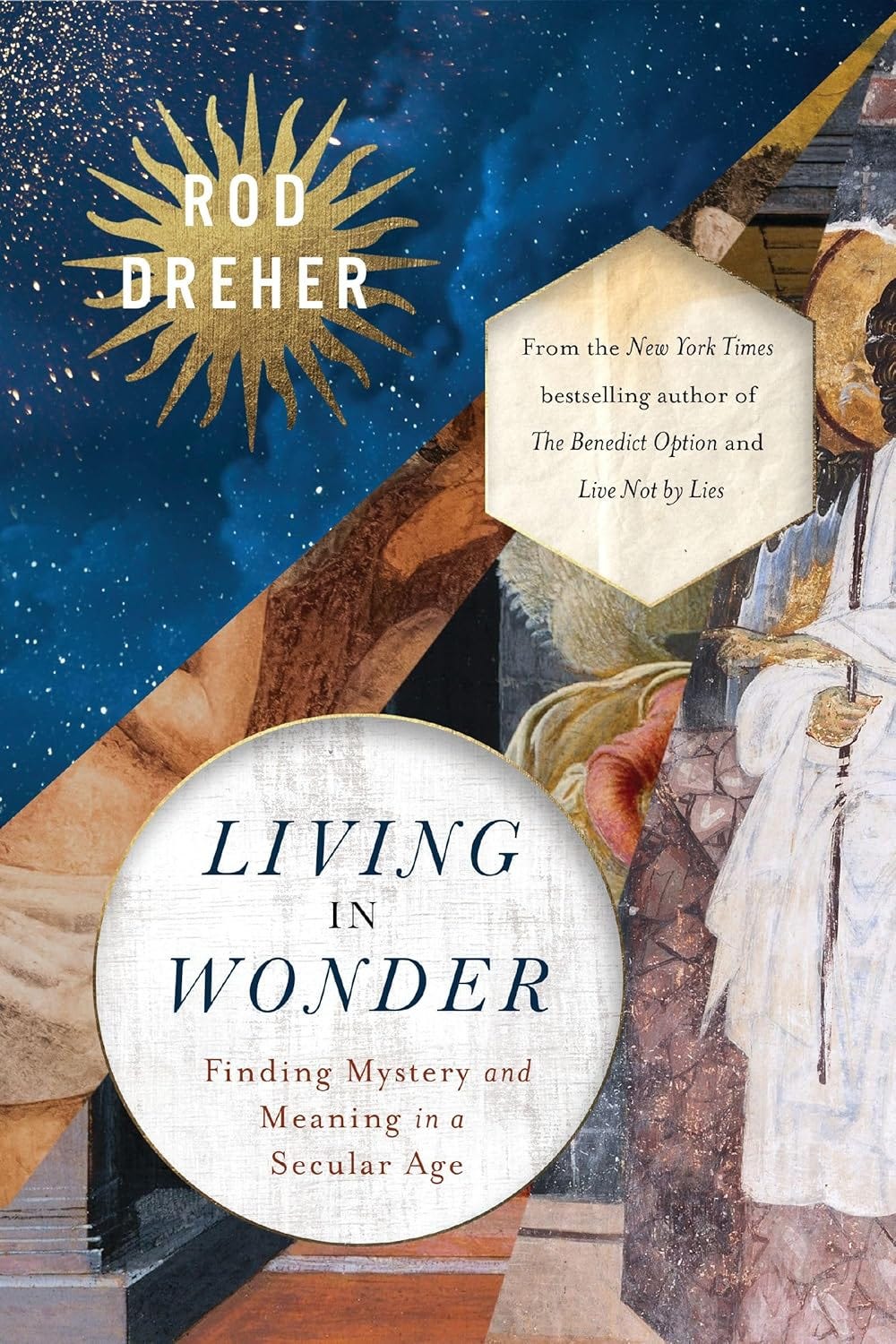
In the first part of the book, Dreher unpacks what it means that we live in a “disenchanted” age. Over the course of several centuries, the dominant cultural mindset shifted from one that saw the world as purposeful, inherently meaningful, and connected to the infinite and eternal to a mindset that sees all meaning and value as subjective and the material world (including the human body) as a mere thing to be manipulated and used however we will.1 We have largely lost any sense of the genuinely transcendent, of the sacred, of mystery, of wonder. As a result, Dreher writes, “We can no longer see what is really real.” We have embraced an inherently and exclusively “left-brained” approach to reality, assuming without reason that anything which resists precise logical analysis or rigorous empirical confirmation is ipso facto unreal. “The left brain is intelligent,” Dreher writes, “but it is not wise.” To become enchanted, or re-enchanted, we must allow the right side of the human brain its proper place in discerning truth. To unravel the most pernicious intellectual errors of the last few centuries, we need to reject the scientistic ethos that has reigned supreme for several generations and embrace “art, poetry, music, and religion as ways of knowing.”
The need for enchantment runs deep in the human psyche, and in the second part of the book, chapters 4-6, Dreher identifies some of the ways in which many people are beginning to seek it outside traditional religion. He notes four in particular: occult practices, psychedelic drugs, digital technologies (primarily AI and virtual reality), and aliens. There is no necessary connection between these, and Dreher does not imply otherwise. He does, however, see them as interwoven in important ways, and he expects that each and all of them will become increasingly prominent in the coming years. Indeed, his expectation is that we will soon see the rise of a new, high-tech, global religion, with revelations about UFOs (or UAPs, as in-the-know folks have started to say) as one of the first dominoes to fall. Aliens “will be part of a religion built for the scientific age, which already has learned to worship science, technology, and the future.”
It’s impossible, of course, even to speculate on such things and not sound like a crackpot conspiracy theorist, but I warned you above that the book gets weird, and Dreher deserves credit for staying within the bounds of what can actually be said to be known right now about all of this stuff. He also does a good job of striking a virtuous balance between gullibility, on the one hand, and excessive skepticism, on the other. [That distinction isn’t central to Living in Wonder, but it’s something I’ve long thought we need to pay more attention to. If you’re interested, click on the YouTube link below for some of my own thoughts on the matter.] His discussion of demons and the occult parallels his discussion of aliens in this regard: it’s possible to err by obsessing about these things, but it’s also possible to err by dismissing or ignoring them. Prudence dictates an approach between these extremes.
Recognizing the possibility of becoming enchanted by things that will ultimately destroy us, Dreher turns in the last part of the book to practices and ideas that can lead to a healthy and holy enchantment. His positive proposals begin with chapter 7, on prayer, which includes some nice insights from two opposite ends of the Christian spectrum: the ancient desert monastics, with their liturgical and bodily practices of prayer, and contemporary charismatic Protestants, with their expectation that God speaks to us and his voice can be discerned in prayer. Dreher believes that we can—and must—learn from both. Chapter 8, “Learning How to See,” emphasizes the centrality of beauty and the power of stories—characteristically right-brain stuff—as effective tools in piercing through the cynicism, skepticism, and nihilism of so much of the contemporary western world. Chapter 9 presents several accounts of miracles in the modern world. The only note I wrote to myself on this chapter is that “it’s really something.” Chapter 10 gives us “Three Prophets of the Real,” Martin Shaw, Paul Kingsworth, and Jonathan Pageau; Dreher shares short interviews with each.2 Important themes in this chapter include the need for a more ascetic approach to Christian faith, a deeper connection to the natural world and a sacramental understanding of it, and the value of structured, liturgical prayer.
The epigraph of chapter 10, a quote from Catholic theologian Karl Rahner, comes close to being a thesis statement for the whole book: “The devout Christian of the future will either be a ‘mystic,’ one who has experienced ‘something,’ or he will cease to be anything at all.” In light of everything Dreher gives us, it is difficult to disagree.
You may have already inferred from the tone of this summary that I think Living in Wonder is a very good book. If you did so, you are correct. Indeed, I would be so bold as to suggest that it is a genuinely important book, and that Christians of all stripes—especially those in leadership positions—would do well to read it and discern whether and how its message may be relevant to their lives and work.
This is not to say the book is without flaws. The most glaring of these is Dreher’s decision to overlook entirely the Eastern Rite Catholic Churches as viable sources of the mysticism and enchantment he seeks. Dreher himself left the Roman Catholic Church—a grave error, in my view—in the wake of the sexual abuse scandal in the early 2000s and became Orthodox. I do not deny for a moment that we western Christians have much to learn from our Eastern brothers and sisters. I do, however, feel compelled to note that Catholic Christians can do so within our own communion; there is no need to break with the Holy Father and the Magisterium in order to find the resources for a more deeply mystical and re-enchanted Christian faith. It’s a shame that the Eastern Catholics do not seem to be on Dreher’s radar. As a Catholic myself, I worry that Latin Rite Catholics who are unaware of the diversity within our own Church may get the impression from Dreher that Orthodoxy is the only game in town.
My other principal critique of Living in Wonder concerns Dreher’s borderline rejection of rational apologetics, even as he acknowledges throughout the book—and as late as on page 259 of its 261 pages—that “mystical experience alone cannot suffice” because it “can only be interpreted within a doctrinal frame based on Scripture and authoritative church teaching.” He notes that “To step outside of that [authoritative teaching] is to risk grave error.” Amen to that. It is the work of apologetics, broadly construed, to point people toward the truth of the Christian faith and to understand more deeply what it means to live within that truth. There are places where Dreher comes perilously close to implying an either/or approach: mysticism matters, therefore apologetics do not! As is so often the case, however, the reality is a both/and: we should be captivated by God in our hearts and also love him with our minds. The same St. Paul who speaks of being “caught up to the third heaven” in 2 Corinthians 12 is also the St. Paul who debated the Stoics and Epicureans in Acts 17. As someone whose own journey to Christian faith was inextricably bound up with intellectual questions, I’d be remiss if I failed to point this out. Rational apologetics is not the end, but for many people, it is part of the way. We no longer live in the world of the 1990s (when I came to faith as a college student) and we must not make the mistake of preparing to fight the last war. But some of the battles in the coming wars will be fought on familiar ground.
Again, however, Living in Wonder is on the whole a very good book. A short review like this one cannot possibly capture how engaging it is. I hope it will be widely read and that its central message—that we need to lean into beauty and story and mystery, all the right-brained stuff that has been dismissed too long—will be embraced even more widely. The faith of the future is going to be weird. God willing, this will be true inside the Church as well as without.
Click here to find Living in Wonder on Amazon or here to buy it from the publisher.
My use of the phrase “the dominant cultural mindset” will naturally lead some to ask, “which dominant cultural mindset,” but that’s a more difficult question to answer than you might expect. I was tempted to use the language of “the western mind,” but that won’t quite fit: Dreher goes on to argue that the western world—western Christians in particular—need to recover the traditions of eastern Christianity. I know that there are some who will insist that Christianity in all its manifestations is ultimately a “western” thing, but this way of talking about west and east gets confusing pretty fast. Suffice it to say: if you insist on knowing what is meant by “the dominant cultural mindset,” I will say that it is the broadly European mindset that traces its roots back to the Greek philosophers and ancient Hebrew religion.
Let me note that the phrase “the old magic is still about,” which I used as the title of this essay, is Shaw’s rather than Dreher’s. It’s found on page 217.