
Divine Signs
Why I Am Catholic, Part IV: Some Weird and Remarkable Things That Happened to Me

Over the last few weeks, I’ve been writing about my religious journey from Evangelical Protestantism to Roman Catholicism. I’ve explained how my initial anti-Catholic biases were shed, my worries that real Christian unity—the sort of unity that the Bible seems to present as normative—is impossible if Protestantism is true, and (in one long essay that probably should have been two) about problems inherent in the Protestant principle of sola scriptura and how my own thinking about sexual morality moved me closer and closer to Rome. There’s also a prequel explaining my initial embrace of Christianity as a freshman in college, in case you’re interested in exploring the whole Matthew Carey Jordan cinematic universe.
One of the things you need to understand in order to appreciate my conversion is that I had some very compelling personal reasons not to become Catholic. My wife, like so many other American kids in the 1980s, was baptized in the Church but experienced a stereotypically bland form of Catholicism, not unlike the insipid mainstream Protestantism I myself endured through childhood. You know the kind of thing I’m talking about: an approach to Christianity that offers little or nothing more than exhortations to be nice. It’s an uninspiring, lifeless, and frankly boring approach to religion… an embrace of the cultural status quo with a little bit of religious language sprinkled on top. It’s the sort of religion that makes the existence of martyrs completely incomprehensible. Who on earth would die for that? Indeed, it makes waking up early on Sundays almost equally incomprehensible. Why go to all the trouble of attending church if it’s just offering the same stuff you can find anywhere else? Suffice it to say that there was nothing in the Catholic faith as Jen experienced it in childhood to make her think it was worth taking seriously.
Early in high school, Jen was invited to the youth group at a Protestant church, and there, for the first time, she encountered a form of Christianity that had real life to it. People were enthusiastic about their faith, they were talking about a personal relationship with God, they were engaging with the scriptures and seeking to discern and follow God’s purpose for their lives… it was meaningful, rich, challenging, inspiring, and a source of real community: everything her Catholic experience hadn’t been. Jen encountered Christ in a powerful way and was “born again” in the context of Evangelicalism, and she continued to walk with the Lord as a self-consciously Protestant Christian through the years that followed, including our dating relationship in college and the first decade of our marriage. So, when I announced to her one day in late 2010 or early 2011 that I was thinking about becoming Catholic, she was less than pleased. The idea that I would even consider leaving the vibrant, loving community we were part of in favor of the impersonal and spiritually dead world of Roman Catholicism was absurd. It would have been funny, if so much were not at stake. And there were the kids to think of, too. Our four sons and our daughter were involved in various children’s programs at Gateway Baptist Church, where they were growing in their faith and becoming part of the community themselves. Add to all of this that Jen had plenty of qualms about the content of the Catholic faith—Don’t Catholics believe that you earn your salvation by performing good works? And what about all of the praying to saints and stuff?—and it is quite understandable that she was deeply opposed to me crossing the Tiber.

On my side of things, I wasn’t yet completely certain that I wanted to become Catholic, but it was emerging as a real possibility, and I was hoping that if I did take the plunge, my wife would be right there with me. I naively believed that she just needed to think through the same issues I’d been wrestling with and she’d wind up in the same place. To her credit, Jen was willing to listen. I shared my worries about the Protestant doctrine of sola scriptura as well as what I’d learned about the biblical, historical, and theological warrant for some of the Catholic doctrines she found objectionable… but none of it hit home. It became pretty clear that if I was going to enter the Church any time soon, I was going to be doing it alone. More than that, I was going to be imposing a heavy burden on my wife.
For this reason, even as Catholicism became increasingly attractive to me, I decided that I could not become Catholic unless I must become Catholic. And indeed, for a period of well over a year, I convinced myself that I did not need to be Catholic. I was mowing the lawn one day and thinking about the various theological issues that were bothering me—as one does—and it struck me vividly that some of my greatest Christian heroes had lived and died outside the Catholic Church. C. S. Lewis and Dallas Willard were the most prominent among them. If Lewis and Willard could live faithfully as non-Catholic Christians, I decided, I could too. I went into the house and told my wife that I had determined I did not need to be Catholic and was going to stop pursuing the matter. And for about fifteen months, I did. I went cold turkey. I quit reading about Catholicism, ceased listening to podcasts about it, and did my best to shut down the part of my mind that was frustrated with Evangelicalism and kept asking awkward questions about it. I determined that God had placed me in a particular Christian culture at a particular time, and even if I didn’t feel at home in it, it was my duty as a husband and father to seek to live faithfully within that culture. I was in the uncomfortable position of believing that Catholicism was probably true but that I should not embrace it.
I’m getting ahead of myself, however. The point of this post is to highlight some of the things that happened along my way into the Church that were experiential rather than intellectual or theological. The first of these took place early in my investigation into Catholicism, subsequent to reading Frank Beckwith’s book Return to Rome. I was aware of the book because Beckwith had caused a bit of a stir in my professional circles a few years earlier. Recall that I’d earned my master’s degree at Biola University, which was kind of the center of the—admittedly small—world of Evangelical philosophy. Beckwith was not on the Biola faculty, but he was friends with a number of my professors and gave several invited talks and chapel addresses during my time there.

In 2007, Beckwith, though by training a philosopher and not a theologian, was serving as the president of the Evangelical Theological Society (ETS) when he decided to revert to the Catholic faith in which he’d been baptized. Initially, as I recall the story, he had no intention of stepping down from his position at ETS. He believed he could still affirm, in good conscience, the ETS statement of faith, so there was no reason for him to cease serving as its president. It quickly became clear, however, that a very sizeable percentage of the ETS membership would not tolerate a Catholic president of the organization, and to avoid further controversy, Beckwith resigned from his position.
Return to Rome is the story of Beckwith’s reversion to the Catholic faith. I found it immensely helpful, myself, particularly for its explanation of the relationship between faith and works (which, as I noted in an earlier post, is taken by many people to be the central issue that separates Protestants from Catholics). Reading Beckwith’s book persuaded me that there is no conflict between the doctrines of the Catholic Church and what the New Testament teaches about the nature of salvation. There is a conflict between the standard Protestant interpretation of the New Testament and Catholic teaching, of course, but that’s a very different thing.
I should say more about faith and works before I bring this series to a close, but I won’t do so right now. For the moment, I’ll just mention that this was the most prominent intellectual hurdle I had to clear in order to seriously consider becoming Catholic. Even after I’d started to worry about sola scriptura and the Protestant understanding of the Bible, I could not view Catholicism as a real possibility for me, personally, unless I was satisfied that the Church’s teaching on this topic was compatible with St. Paul’s writings. I’d been told for years that what the Church says about how we are saved is precisely what Paul condemns in his letter to the Galatians, and when push came to shove, it didn’t really matter how compelling the Church’s other claims were if she was wrong about this one. Reading Return to Rome helped me to clear that hurdle.
This did not mean, however, that I was ready to enter the Church. There were lots of other intellectual obstacles I needed to overcome, and I sent Beckwith an email to inquire whether he’d written anything about Mary and the saints, the papacy, or other topics I was wondering about. He graciously wrote back and informed me that, other than a few essays for The Catholic Thing, he had not written much else on Protestant-versus-Catholic stuff. He recommended that I take a look at the Called to Communion website, which had been created by a group of former Protestant pastors who had entered the Church.

Called to Communion is a pretty impressive resource, and I began to spend a lot of time exploring it. Not everything I read there resonated with me, partly because I had never embraced the Calvinistic brand of Protestantism that dominated the discussions there, but it was helpful. They also had a podcast that I listened to regularly in the car. I was living in Alabama and working full-time at Auburn University’s Montgomery campus, but for several semesters I taught an evening course at the main campus in Auburn, about forty-five minutes away. This gave me plenty of time to consume podcasts and audiobooks. The Called to Communion podcast was hosted by a man named Tom Riello, who piqued my interest with an offhand comment in one episode about being located “in the great state of Alabama.” I guessed that he was probably in Birmingham, an hour or two north of me, since that’s where the Catholic broadcasting network EWTN has its headquarters.
At some point, I was wrestling with an objection to Catholicism to which I couldn’t find a clear answer online. I don’t recall what the specific topic was, just that I was unable to find anything that straightforwardly addressed it. It struck me that perhaps I could arrange to meet up with this Tom Riello fellow and talk with him about it. Our family made occasional trips to Birmingham to visit the science center there, and I thought that maybe I’d be able to drop Jen and the kids off there sometime and meet Riello for coffee.
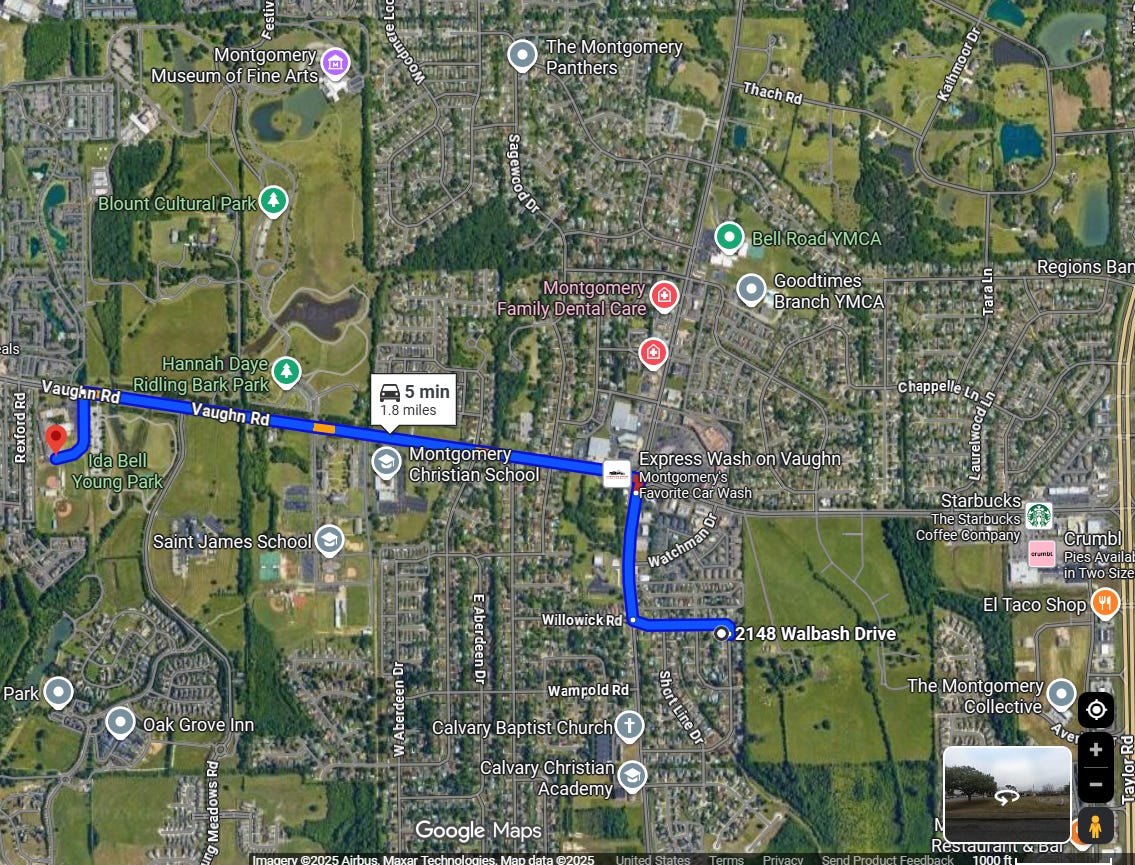
Frustratingly, Tom Riello was the only contributor to Called to Communion whose email address was not on the website. I eventually found him on LinkedIn, however, and to my astonishment discovered that he was not in Birmingham after all but in Montgomery. Indeed, not just Montgomery: he was a theology teacher at Montgomery Catholic Prep, just down the street—1.8 miles, to be exact—from my house.
This was really extraordinary.
Perhaps it goes without saying, but in addition to doing lots of reading and thinking about theological questions, I was also praying for God’s guidance throughout this time. I was hoping for some kind of sign. If God wanted me to become Catholic, in spite of my wife’s objections and all the difficulties that would be entailed by my conversion, I prayed that he would give me some kind of indication: something over and above and independent of the intellectual stuff I was engaging with.
Well, this sure seemed like such a sign. It’s not always easy to discern what God is up to, and anyone who knows me knows that I am skeptical to a fault when I hear about purported miracles. Nonetheless, I would submit that this event meets the criteria we normally use to establish whether something is the result of mere chance or the work of an intelligent agent. Consider the context. I had read Frank Beckwith’s book and reached out to him. Beckwith recommended a website to me. The contributors to the website could have been located, for all I knew, anywhere in the English-speaking world. When a situation arose in which it made sense for me to reach out to one of them and attempt to connect, it turned out that the person I wanted to speak with worked at the closest Catholic institution of any kind to the house where I was sitting at my desk trying to find his email address. He could have been anywhere on the planet. It turned out he was just down Vaughn Road.
Four years later, Tom Riello would be my sponsor when I entered the Church. But a lot of other things had to happen first.
Don’t forget that I was being pulled in two directions. On the one hand, I was increasingly attracted to the Catholic faith and increasingly impressed by the intellectual case for Catholicism. On the other hand, I had a wife and kids to consider, as well as a broader network of friends, and it was clear that becoming Catholic would, at a bare minimum, make my life a lot more difficult. Worse, it would make my wife’s life more difficult. As I said above, I felt that I could not become Catholic unless I had to become Catholic. In a similar vein, I felt obliged to try to be talked out of it.
Over the course of a couple of years, I met regularly with my pastor—a good man who remains a good friend, by the way—to talk about the issues I was wrestling with.1 He had a lot of respect for the Catholic tradition but was convinced that Protestantism was a better and more faithful expression of Christianity. We would talk for hours, often late into the night, and we exchanged emails that were thousands of words long. These conversations helped us both to clarify our thinking, but I was unable to get him to see what I found so compelling about Catholicism and he was unable to get me to feel the force of his reasons for rejecting it.
At the pastor’s suggestion, I arranged to meet with a fellow parishioner at our church, a guy named Dave O’Meara. Dave had been raised Catholic and practiced the faith into early adulthood, but had been attending Evangelical churches for many years. If memory serves, he was then a deacon in our Baptist church. He was certainly a faithful man and a leader in the community. I asked him if we could meet for coffee, but I didn’t tell him in advance what I wanted to discuss. As we sat in the Starbucks near the intersection of Vaughn and Taylor Roads I explained what was on my mind.2 It gradually became clear to Dave that I was seriously thinking of becoming Catholic. His eyes started to well with tears. “Uh-oh,” I thought, “Dave thinks this is a really, really bad idea.” I’m not sure what exactly I expected him to say, but I braced myself for an extremely harsh rebuke. To some degree, I was hoping for a harsh rebuke, and for a compelling reason to back away from the ledge and cease considering Catholicism. That is not what I received. It turned out that Dave was moved by what I was saying because he had never really lost his Catholic faith. He still loved the Church and was grieved that family circumstances had pulled him away from it. He thought it was wonderful that I was moving in the opposite direction. A few years later, Dave moved to Kentucky and returned to the Church himself.
I contacted one of my mentors from Biola University—a friend of Frank Beckwith’s, actually, who had been quoted in Return to Rome—and arranged a phone call with him.3 I told him what I was wrestling with and the principal reasons I was considering becoming Catholic. As we wrapped up our conversation, he said, “At the end of the day, I don’t believe that what the Catholic Church claims about itself is true, but if you do wind up becoming Catholic, you’ll have no bigger supporter than me.”
In short, my efforts to be talked out of Catholicism were not going well. But there was still one big opportunity in front of me.
As I have noted here and elsewhere, C. S. Lewis is one of my intellectual heroes. I fell in love with the Narnia books as a kid, and in college I discovered Mere Christianity and many of Lewis’s other religious writings. I’ve been reading his work consistently ever since. One of the great privileges of my life has been leading Lewis-themed study abroad trips and pilgrimages to Oxford, England, which is where he spent the bulk of his adulthood. [By the way, if you’re interested in joining one of these pilgrimages, you can find more information and sign up for email notifications about upcoming trips here.] The first time I led a group to Oxford was in the summer of 2013. The trip was connected to a class I was teaching at Auburn Montgomery, and as my students and I were sitting in the Montgomery airport, waiting to board our flight, I took out my laptop and composed an email to a man I’d never met: the C. S. Lewis scholar Michael Ward.
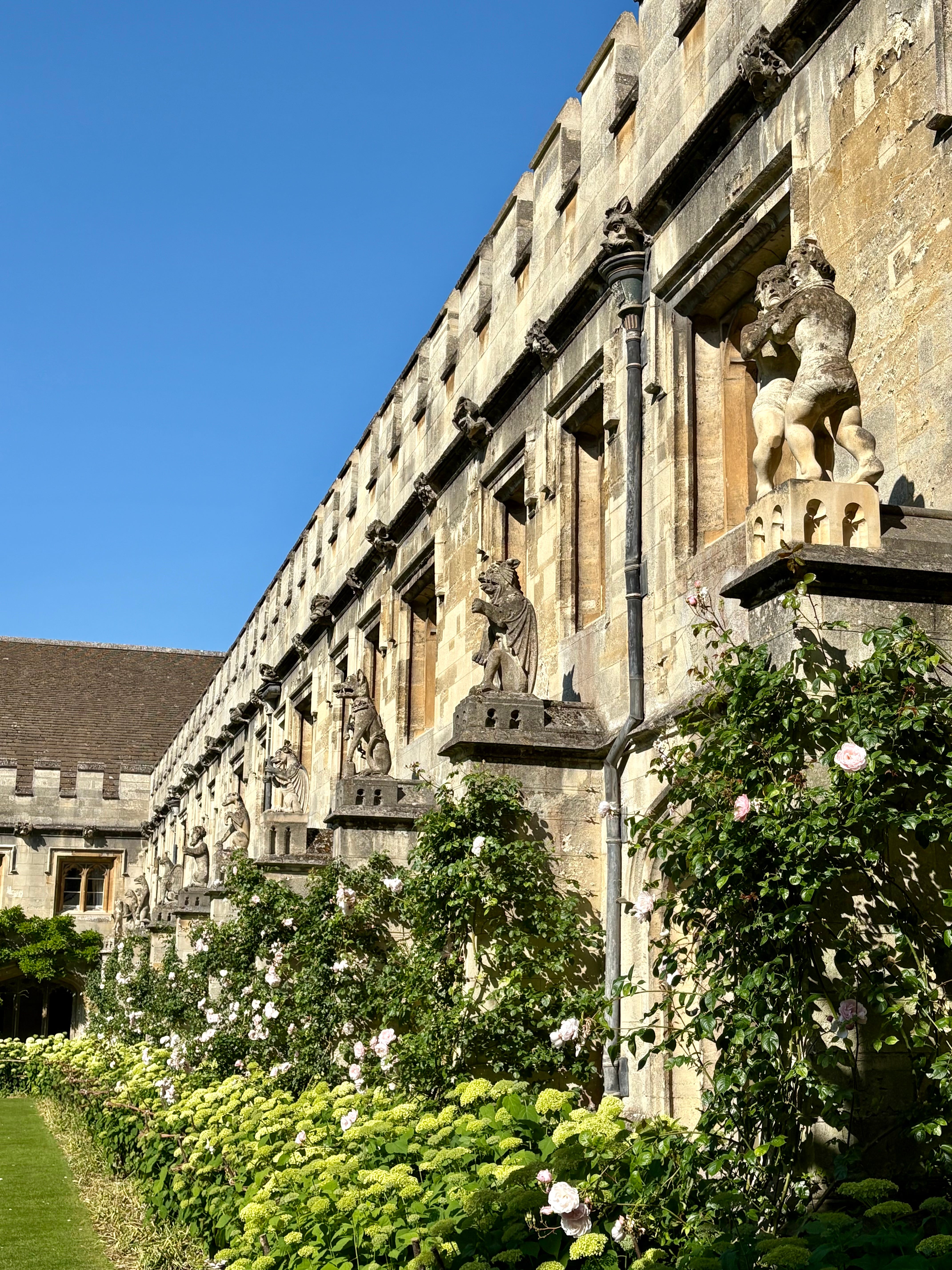
A few years earlier, Ward had written a book which can be described, without hyperbole, as the most significant work of Lewis scholarship in the last twenty years: Planet Narnia. I will resist the temptation to summarize it here. Let it suffice to say that the book is absolutely fantastic. I’d heard of it soon after it was published, but I didn’t get around to reading it until a few months prior to the trip with my students. There in the Montgomery airport, I found Dr. Ward’s email address and sent him a short message. The gist of it was that I was going to be in Oxford for a few days and would love to meet him and discuss his work, if perchance he was available to meet for a glass of beer or a cup of tea.
By the time my students and I had arrived in Oxford the next day, I had received a response. Dr. Ward was indeed available to meet with me. He proposed 2pm on Thursday at the Queen’s Lane Coffee House, noting that he would need to conclude our meeting by three o'clock sharp. Whether this is because he genuinely had somewhere else he needed to be or because he prudently wanted to establish an escape clause if I turned out to be a weirdo, I cannot say.
Now, while it is emphatically true that I wanted to meet Dr. Ward and talk about Planet Narnia with him, I had an ulterior motive. As I noted above, C. S. Lewis was not a Catholic. He was an Anglican. I knew that Ward, in addition to being a Lewis scholar—with degrees from Oxford, Cambridge, and St. Andrews, I should add—was also an ordained Anglican priest. If anyone could keep me safely away from Rome, I thought, surely he could.
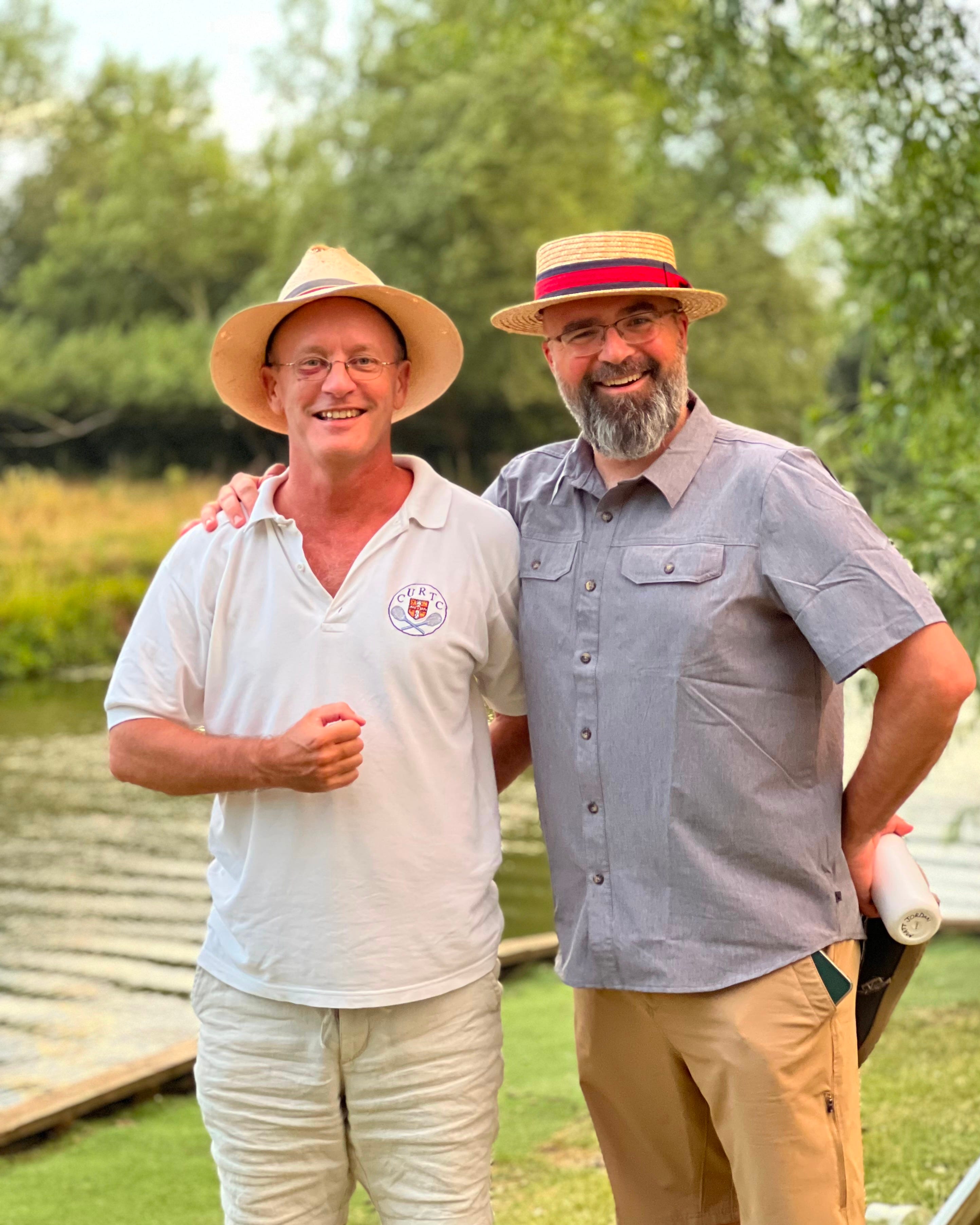
We met as planned, ordered a pot of tea, and had a very pleasant conversation about C. S. Lewis’s life and work. Around a quarter to three, I said something like, “This has all been extremely interesting, and I’d like to keep going with it. But there’s another subject I was hoping to discuss with you.” I paused, and Ward encouraged me to continue. “I’ve been practicing the Christian faith pretty seriously for nearly twenty years. I’ve been in the Evangelical world the whole time, but I’ve recently been asking some questions and doing a lot of thinking, and I’m starting to seriously consider becoming Catholic. To be blunt, I’m hoping you might be able, as both a Lewis scholar and an Anglican priest, to help me understand how I can honestly remain a Christian without being a Catholic.”
“Well, that’s very interesting,” Ward replied, “I was received into the Church myself a little less than a year ago.”
This was not exactly the knock-down argument against Catholicism I was expecting.
I asked Ward to tell me about his reasons for becoming Catholic, and he proceeded to list exactly the same considerations that were part of my own story: problems with sola scriptura and the need for a Magisterium, the ancient pedigree of many Catholic beliefs and practices, and the Church’s unique fidelity to a traditional Christian understanding of sexual morality. It was a really remarkable moment for me. Here I was, on the other side of the Atlantic, having scheduled this conversation for the purpose of being talked out of becoming Catholic, and the man across the table from me was naming and endorsing the very same ideas that were leading me Romeward. Again: it was remarkable.
Indeed, along with other unexpected conversations and encounters, particularly the way my path had crossed with that of Tom Riello, this sure felt like a divine sign, like God was nudging me along on the road to Catholicism. It still feels that way. I might be so bold as to suggest to any skeptical Protestant reading this essay that if, say, an agnostic were to share with you stories like mine, except with a leading toward nondenominational Christianity rather than Catholicism, you would almost certainly see the hand of God at work behind the scenes.
Interestingly enough, while I did perceive God to be at work in these circumstances, my experiences were not sufficient for me to conclude that I needed to be Catholic, at least, not in the sense that it was something I was required to do. Upon my return from England, I realized I had crossed a threshold and definitely, unequivocally wanted to be Catholic. It was just about a month later, however, that I had the lawnmowing experience described above: in spite of my belief that Catholicism was the fullest expression of authentic Christianity and in spite of my own desire to enter the Church, I concluded that I owed it to Jen and the kids to refrain from acting on that belief and satisfying that desire.
Instead, I did my best to do the opposite. I just stopped thinking about Catholicism, or tried to, anyway. And it went okay… until it didn’t. One aspect of my religious journey that I haven’t highlighted yet is that I struggled with serious doubts about the truth of Christianity for many years after I got serious about practicing the faith. There were at least three distinct occasions when I came very, very close to abandoning religion entirely: the summer before my senior year of college, midway through my PhD program, and soon after we’d moved to Alabama. Less dramatically, I would go through more mundane seasons of doubt, accompanied by sadness and despondency, usually lasting anywhere from one to three months. It was a familiar pattern: I’d be in a funk for a while, then for six months or more I’d feel okay, and then it would be back to a place of frustration and darkness. Wash, rinse, repeat.
Late in the fall of 2014, clouds of doubt and despair moved in once again. For all the good things going on in our church community—and really, there was much to celebrate; it was an excellent church with a terrific pastor, one of the best Christian fellowships I’ve ever been part of—there was just something missing. I’d find myself routinely asking versions of the question what are we doing here? while at church. Is this it? Is this what the Christian faith is supposed to be? Is this worship? Is this what God has given us?
One day in late November, I took my older kids to the church for their Wednesday night activities. Jen and one or two of the youngest stayed home; someone was sick that day. Normally, I would have stayed at the church myself to attend the adult Bible study, but I didn’t have it in me that night. I was aware that Holy Spirit Catholic Church had a Wednesday evening Mass that I had just enough time to get to. So I dropped the kids off at their classrooms, snuck back out to my car, and drove to Holy Spirit.
I wish I’d made a note of what the priest, Fr. Patrick Driscoll, said in his homily that night. I have no memory at all of what the topic was, but whatever he said, it was exactly what I needed to hear. And beyond the words he spoke, there was a palpable sense that something was there in that Catholic church. It wasn’t overwhelming or dramatic, but it was real. There was something present—there was a Presence—that resonated somewhere deep within me.
At the conclusion of the Mass, I felt spiritually refreshed and encouraged in a way that I hadn’t for a very long time. I made it back to the Baptist church in plenty of time to pick up my kids, and later that night or early the next morning, I shared with Jen what I had done and how I had felt. “I’m not asking for your blessing for me to become Catholic,” I said. “But I think I need to start attending Mass.” Jen didn’t love this idea, but she didn’t hate it, either. She’d endured a lot, putting up with my seasons of depression, and the idea that attending Catholic services might make me a more pleasant person to have around was no doubt an attractive one. It was certainly a less expensive option than professional counseling, which was something I was starting to consider! And besides, I wasn’t asking her or anyone else to come with me, nor was I planning to abandon our Baptist church. I just wanted to add regular attendance at Catholic liturgies to my schedule.
So that’s what I did. Beginning in early Advent 2014, I started attending weekly Masses on my own, usually going to the seven a.m. service at St. Peter’s in downtown Montgomery on Sunday mornings, then coming home to help get the kids ready and out the door for Sunday school and the worship service at Gateway Baptist. It wasn’t ideal, but it went pretty well. It certainly had good effects on me and on my disposition.
Early in 2015, Michael Ward—the C. S. Lewis scholar I’d met in Oxford—was coming to Alabama to give a talk at my university. I’d known he was going to be in the United States for a while, and I arranged for him to speak at Auburn Montgomery as well as at a university down in Mobile, about two and a half hours away. I was very pleased about the latter engagement, as I was to be Dr. Ward’s chauffeur for the drive to Mobile, which meant I’d have quite a bit of time to chat with him.
Unsurprisingly, our conversation turned to matters of faith. I’ll share some of the details whenever I get around to writing the last post in this series. For now, I’ll just say that those hours we spent on I-65 South turned out to be very consequential. By the time I had returned home to Montgomery that night (Dr. Ward stayed in Mobile), I was convinced that I needed to take a step of faith and enter the Catholic Church, in spite of the ways it would likely complicate my personal life.
The next morning, my wife asked me how my time with Michael Ward had been. I started to explain everything he and I had discussed, but before I got very far, Jen found herself saying—and this is how she describes it herself; she was a bit surprised at the words that were coming out of her own mouth—that if I needed to become Catholic, well, then I should become Catholic. “I’m your wife,” she said, “and I will support you. If this makes things weird with our friends or with other people at church, so be it. I’m committed to you, and if this is what God is calling you to do, you need to do it.”
It was a Saturday morning when Jen said that to me. The same weekend, our pastor friend—the one with whom I’d had so many lengthy discussions about Catholicism—was back home in Louisiana, where he’d been raised. I believe he was in Baton Rogue. I don’t recall the main reason for his trip, but while he was there, he arranged to have coffee with a fellow Louisiana native with whom he’d corresponded: the author and commentator Rod Dreher, whose excellent book How Dante Can Save Your Life was just about to be published. The pastor was doing some regular blogging at the time, and the first essay he posted after his trip home was about the time he spent with Dreher. I haven’t been able to find the precise quote, but the main lesson he drew from that exchange was that Jesus really was at the heart of all the great Christian traditions. He said something along the following lines: “It struck me that here I was, a Southern Baptist pastor, talking with an Eastern Orthodox writer about a medieval Catholic poet, and fundamentally, all three of us are focused on the same thing. The differences between us are real, but what we have in common is deeper and more important than what we don’t.”
Now, reading those words on my friend’s blog was not as extraordinary an experience as connecting with Tom Riello or my conversation with Michael Ward in Oxford. But the timing was striking. For my friend to write such a thing immediately in the wake of my I-65 discussion with Ward and my wife’s unexpected blessing of my desire to enter the Church… it was really something. It felt like one more divine sign: one more—and in this case, one final—confirmation that God wanted me in the Church. I contacted Fr. Driscoll at Holy Spirit and updated him on my circumstances. Seven weeks later, I would receive my First Communion from his hand.
Next time, I’ll get back to the more properly theological questions I had to wrestle with before I could enter the Church. For now, I’ll close with a word of encouragement to any Protestant who finds himself or herself reading this with a mind open to Catholicism. I don’t know what God has in store for you or why he works so differently in different people’s lives. But if you’re open to the possibility that Catholicism is true, it surely couldn’t hurt to ask him to show you whether or not it is. I don’t know if you’ll wind up with your own Tom Riello and Michael Ward stories… but you might.
In any event, if you have questions about my journey into the Church or about Catholicism more generally that I haven’t addressed yet in this series, let me know in the comments. And if you’re enjoying these posts, please take a moment to click the like button, share them with someone who might be interested, and subscribe to Less of a Theory.
I don’t have any plans to add a paid subscription option to my Substack, but if you’d like to express your support for my writing, you can always
The coffee shop where I sometimes write charges $2.85 for a medium coffee, in case you’re wondering. Thanks for reading!
I’m keeping him anonymous here only because I don’t know if he wants to be identified. But if you’re reading this, pastor friend, let me know if I should update this post with your name!
I would like to note for the record that, as a lifelong Cleveland fan and lover of the movie Major League, I love the fact that Vaughn & Taylor is a major intersection in the city where I spent nearly a decade of my life. Let him who has ears, hear.
This was the great JP Moreland, one of the most remarkable people I’ve ever known, a great and saintly man. There’s a fun passage in Return to Rome where Beckwith reads a quote from Pope John Paul II to Moreland and asks him to guess who said it. Moreland lists a number of Protestant possibilities before giving up. “It’s Pope John Paul II,” Beckwith tells him, to which Moreland replies, “He’s one of us!”
I’m loving this series, Matt. Your conversion played a crucial role in my family’s crossing of the Tiber. One night after one of your classes (sometime in 2012 or 2013) you mentioned to me that there was a good chance you might become Catholic. At this point I had never really had a reason to consider the merits of the Catholic faith. However, you had garnered enough intellectual respect from me by this time that I figured the case for Catholicism must not be as easily dismissed as I had assumed.
After your reception into the church I think we had coffee and discussed your reasons for conversion. In the midst of the conversation you had recommended that I read Christian Smith’s book How to Go From Being a Good Evangelical to a Commtted Catholic in Ninety-Five Difficult Steps. While this book alone didn’t move us across the finish line, it successfully unsettled my Evangelical Protestant commitments. It was a book Amanda and I would revisit multiple times over the next seven or eight years while we followed the Canterbury Trail to Rome.
Blessings to you, Jen, and the kids!
I love to see Montgomery featured so prominently in this essay! Yesterday, I was at the Basilica of the National Shrine of the Immaculate Conception attending mass and venerating the relics of St. Thérèse of the Child Jesus. Five years ago, I never could have imagined doing something like that.
One of my signs along the road to joining the Church was your Facebook post sometime around June 2021 inviting anyone struggling with religious questions or doubts to reach out to you. I don't recall how specific you were in listing particular questions or doubts, but I remember feeling like you were speaking directly to me. We had not talked in about seven years, but I had been thinking about reaching out to you for a couple months. So for you to invite me to reach out with my questions felt remarkable.
You generously talked with me multiple times. Less than a year later I was confirmed and received my first Holy Communion.